The Food Security Challenge and the Need for Sustainable Agriculture
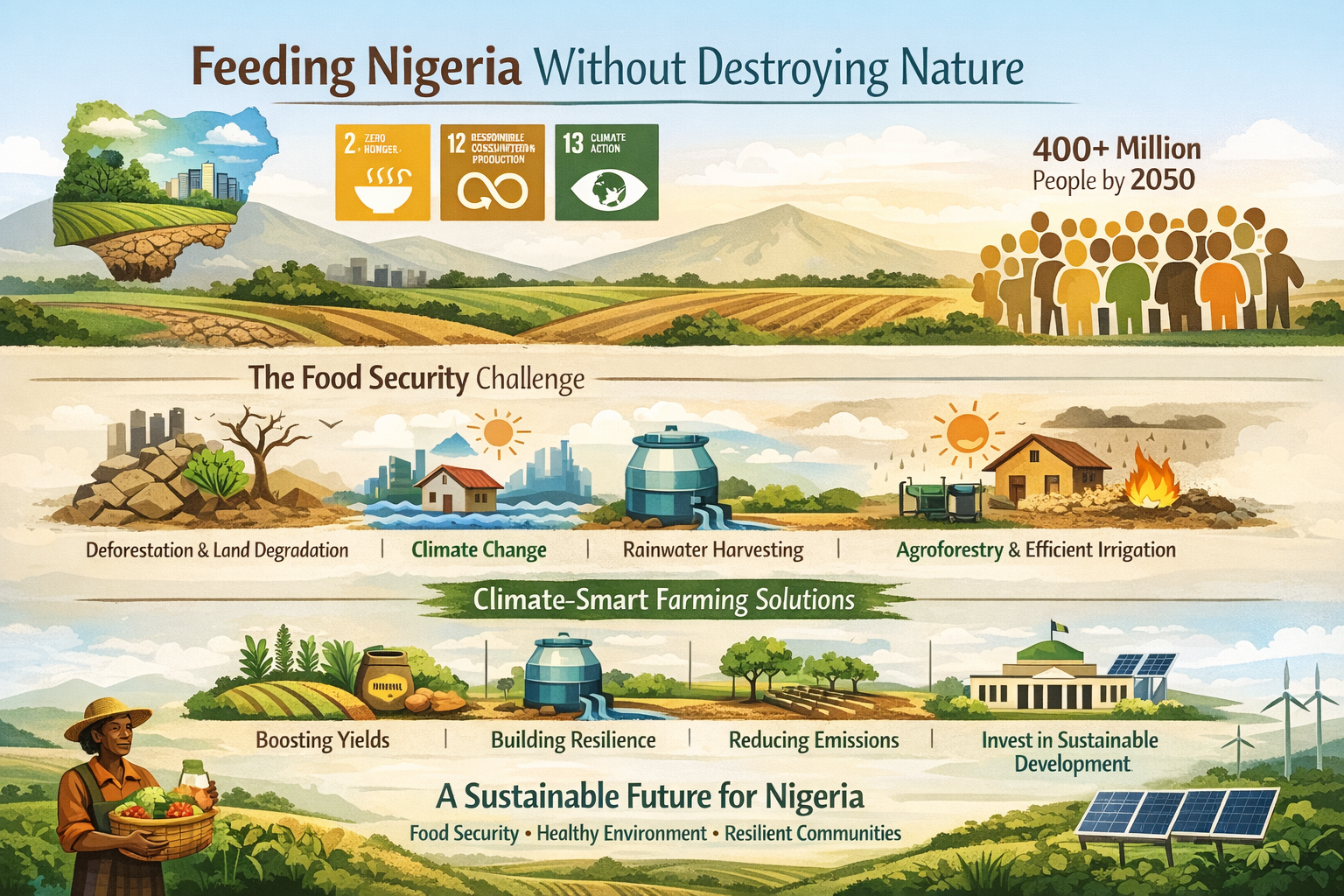
Nigeria faces a growing dilemma of how to feed an expanding population while preserving the natural systems that make food production possible. With projections suggesting the population could exceed 400 million by 2050, the pressure on land, water, and ecosystems is intensifying. Yet, food security in Nigeria is not simply about increasing output; it is about producing food in ways that are efficient, equitable, and sustainable.
Current challenges such as climate variability, flooding, desertification, and soil degradation continue to disrupt agricultural productivity. Unsustainable practices, including deforestation, slash-and-burn farming, and excessive chemical use, may deliver short-term gains but ultimately weaken the foundation of long-term food production.
This is where sustainable agriculture becomes essential. By aligning with SDG 2 (Zero Hunger), SDG 12 (Responsible Consumption & Production), and SDG 13 (Climate Action), sustainable agriculture offers a pathway to produce enough food while protecting ecosystems and supporting livelihoods.
Climate-Smart Farming for Resilience and Productivity
At the core of sustainable agriculture is climate-smart farming, which focuses on increasing productivity, strengthening resilience, and reducing environmental impact. Farmers can boost yields without expanding farmland by adopting practices such as crop rotation, intercropping, and improved, climate-resilient crop varieties. Organic soil amendments like compost and biochar help restore soil fertility while reducing reliance on synthetic inputs.
At the same time, building resilience is critical as farmers face erratic rainfall, prolonged droughts, and rising temperatures. Techniques such as rainwater harvesting, efficient irrigation, and agroforestry help buffer these shocks and stabilise production systems. Beyond adaptation, climate-smart farming also contributes to climate action by lowering greenhouse gas emissions through reduced deforestation, improved manure management, and more efficient farming systems. These approaches ensure that sustainable agriculture supports both immediate food needs and long-term environmental health.
Responsible Consumption, Policy Support, and the Path Forward
Achieving lasting food security requires not only better production systems but also responsible consumption and strong institutional support. A significant portion of food produced in Nigeria is lost due to inadequate storage, transportation, and processing, highlighting the urgent need to reduce post-harvest losses. Tackling food waste can increase food availability, improve farmer incomes, and ease pressure on natural resources without requiring additional land.
Consumers also have a role to play by supporting local, seasonal foods and reducing household waste. However, meaningful progress depends on enabling policies and innovation. Governments must invest in climate-smart technologies, strengthen extension services, and provide incentives for sustainable practices. Advances in digital agriculture and climate data tools can further empower farmers to make informed decisions.
Ultimately, sustainable agriculture offers Nigeria a clear path forward, one that strengthens food security, protects biodiversity, and builds resilience to climate change. Feeding the nation without destroying nature is not just possible; it is necessary for a stable and prosperous future.