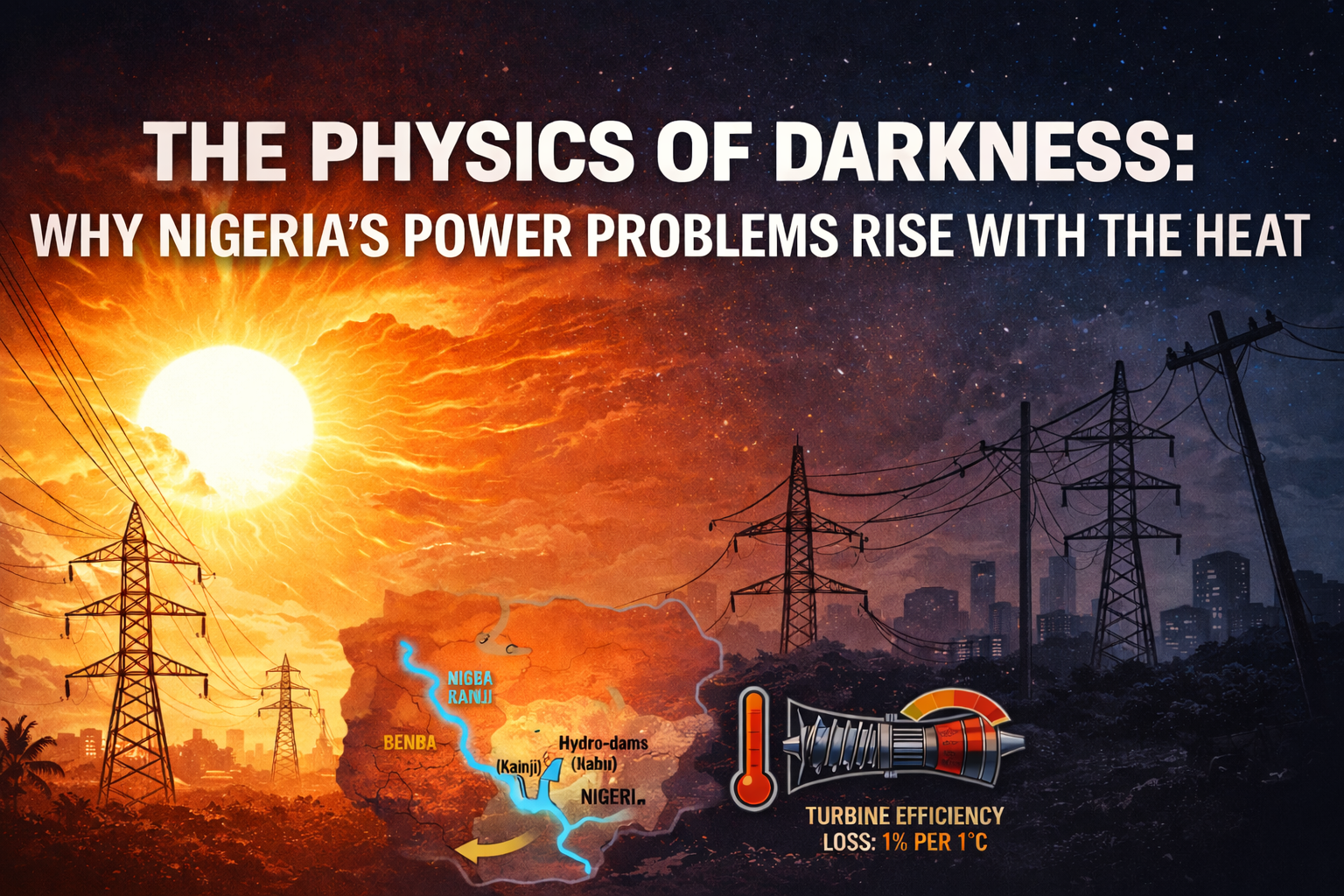
The Physics of Darkness: Why Nigeria’s Power Problems Rise with the Heat
It can be very frustrating to return from a long, exhausting day under the scorching sun. The heat feels unbearable almost like what suya goes through on the grill. You finally get home, turn on the fan or air conditioner and suddenly… the power goes out. If you are fortunate enough to own a generator, you switch to it. Then comes the next worry, your stored food is already beginning to spoil and it’s only Tuesday.
This experience has become all too common. Even in 2026, just like during the 2024 heatwave, power outages seem to increase during extreme heat. The question remains: why does this happen?
To understand this, we must first look at the physics behind it.
Heat is a form of energy transfer, specifically the movement of thermal energy from one object to another due to a temperature difference. In simple terms, when temperatures rise the behavior of matter changes, including the air itself.
Most of Nigeria’s electricity is generated using gas turbines. These turbines rely on air intake to burn fuel efficiently. However, hot air is less dense than cold air. This means that as temperature increases, the amount of oxygen available for combustion decreases. For every 1°C rise above the standard design temperature of 15°C, a gas turbine can lose between 0.7% and 1% of its power output.
In a country already struggling with limited power generation, this loss becomes significant during heatwaves.
Beyond physics, there is also an engineering problem
Nigeria operates a largely fragile and isolated power grid. In more advanced systems, if one power plant fails, electricity can be redirected from other regions through interconnected grids. However, Nigeria’s grid lacks what is known as “spinning reserves”, extra power that is already generated and ready to be deployed instantly when demand spikes.
During extremely hot periods, electricity demand rises sharply as more people rely on cooling systems. At the same time, power generation drops due to reduced turbine efficiency. This imbalance creates stress on the grid. When a major transmission line trips, system frequency drops rapidly. To prevent catastrophic damage to equipment, the entire grid shuts down, resulting in a widespread collapse.
This explains why outages often happen precisely when electricity is needed the most.
However, the problem does not end with physics and engineering, it extends into geopolitics.
Nigeria relies partly on hydroelectric power from major dams such as Kainji and Jebba, both located along the Niger River. This river flows through several upstream countries before reaching Nigeria. If these countries were to construct large dams of their own, they could significantly reduce water flow into Nigeria, rendering its hydroelectric infrastructure ineffective.
To prevent this, Nigeria entered into agreements such as the Act of Niamey (1963/1964), along with later arrangements often described as “Power for No Dam” agreements. These agreements involve cooperation and concessions that ensure upstream countries do not restrict water flow.
While these agreements protect Nigeria’s access to water, they also create strategic limitations. In some cases, power must be exported or shared to maintain regional balance and uphold these commitments.
Finally, the numbers reveal the full picture.
Nigeria has an installed generation capacity of about 13,000 MW, a transmission capacity of approximately 8,500 MW, and an actual consumption level of less than 6,000 MW. This gap is influenced by factors such as gas supply shortages, maintenance challenges, and transmission inefficiencies.
The result is a paradox: Nigeria appears to generate more power than it effectively uses, yet still struggles with consistent supply.
In conclusion, when the heat rises and the lights go out, it is not simply a matter of poor infrastructure. It is the combined effect of physics reducing generation efficiency, a fragile grid unable to handle demand shocks and geopolitical constraints shaping energy policy.